The Applicable Federal Rate (AFR) is the minimum interest rate the IRS requires on certain loans between family members and other related parties. If you lend money at a rate below the AFR, the IRS treats the difference as a gift from lender to borrower — which can have tax consequences for both parties.
The AFR is published monthly by the IRS and varies based on the loan duration.
Why the IRS created the AFR
Without a minimum rate requirement, family members could use low-interest or no-interest loans as an indirect way to transfer wealth — effectively circumventing gift tax rules. The AFR closes that loophole by requiring that loans charge at least a market-equivalent rate. Any interest "foregone" by charging below the AFR is treated as if it were given as a gift.
This rule applies to loans between related parties — which the IRS defines broadly to include family members, corporations controlled by the lender, and certain trusts.
The three AFR tiers
The AFR is divided into three tiers based on the loan term:
| Tier | Loan duration | Typical rate range (2024–2025) |
|---|---|---|
| Short-term | 3 years or less | 4.5% – 5.5% |
| Mid-term | 3 to 9 years | 4.0% – 5.0% |
| Long-term | More than 9 years | 4.0% – 5.0% |
These are approximate ranges. Actual rates change every month and are tied to Treasury yields. The short-term rate tends to be slightly higher because shorter-term Treasuries often carry higher yields in a normal yield curve environment — though this can invert.
The IRS publishes the exact rates each month in a Revenue Ruling (typically around the 20th of the preceding month). Current and historical rates are listed at IRS.gov/applicable-federal-rates.
How the AFR applies to family loans
For your loan to be treated as a genuine loan rather than a gift, you generally need to charge at least the AFR that was in effect when the loan was made. The rate is locked in at origination for fixed-rate loans — you don't need to update it every month.
A few important thresholds:
Loans of $10,000 or less: The imputed interest rules generally do not apply. You can charge 0% on very small loans without IRS complications (with some limitations).
Loans between $10,001 and $100,000: Imputed interest rules apply, but there's a cap: the imputed interest cannot exceed the borrower's net investment income for the year. If the borrower's investment income is $1,000, imputed interest is capped at $1,000 even if the below-AFR shortfall was higher.
Loans over $100,000: Full imputed interest rules apply with no investment-income cap.
What happens if you charge below the AFR
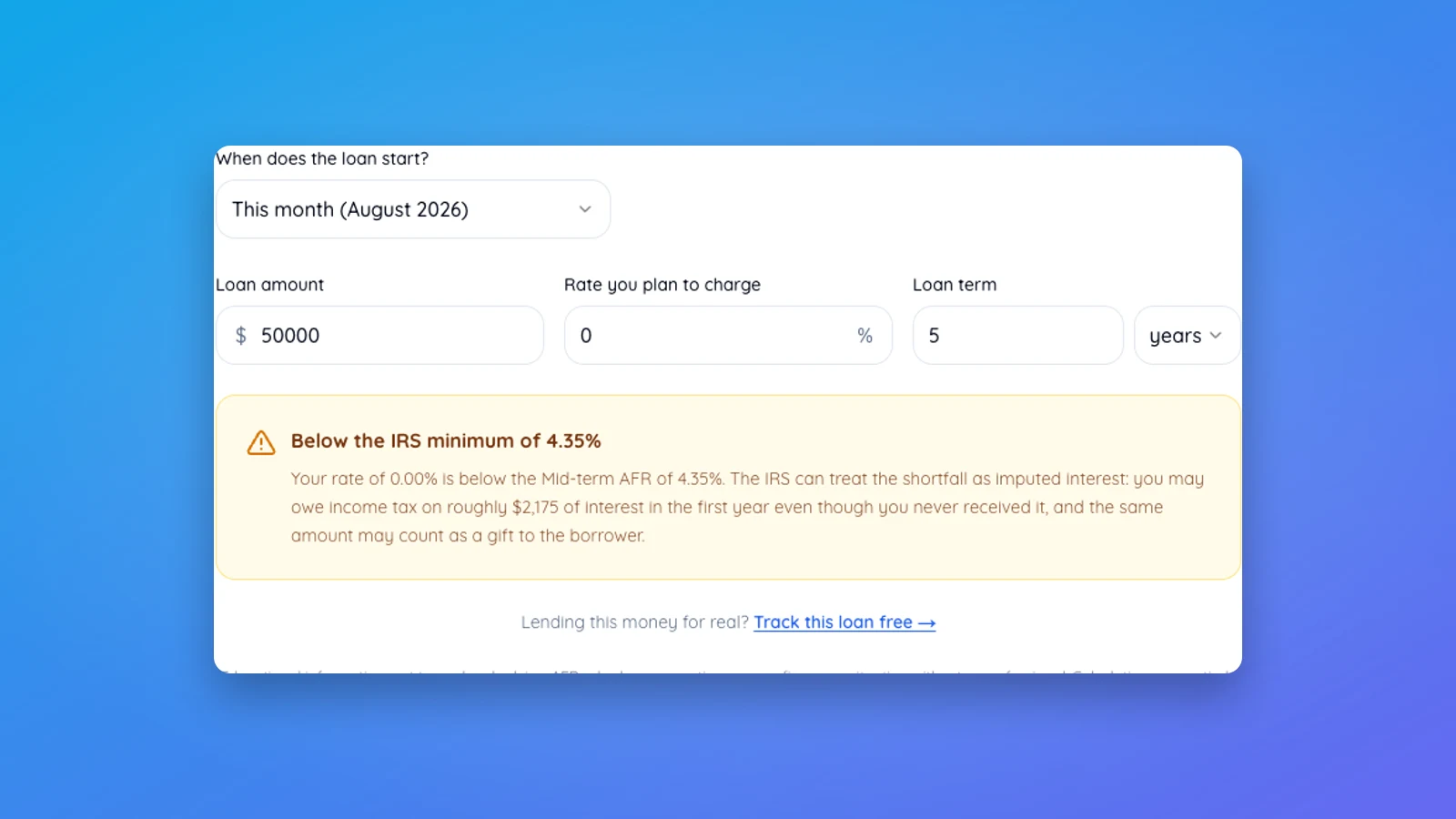
If your interest rate is below the AFR, the IRS treats the "foregone interest" — the difference between what you charged and what the AFR requires — as if it flowed through two transactions simultaneously:
- The lender gives the foregone interest to the borrower as a gift. This counts against the lender's annual gift tax exclusion and, if it exceeds the exclusion, may require filing Form 709.
- The lender is treated as if they received that interest as income. Even though the cash never changed hands, the lender may owe income tax on it.
In practice, for loans below $100,000 where the borrower has modest investment income, the amounts involved are often small enough that the practical impact is limited. But for larger loans, the difference between charging 0% and charging the current AFR can be significant.
How to find the current AFR
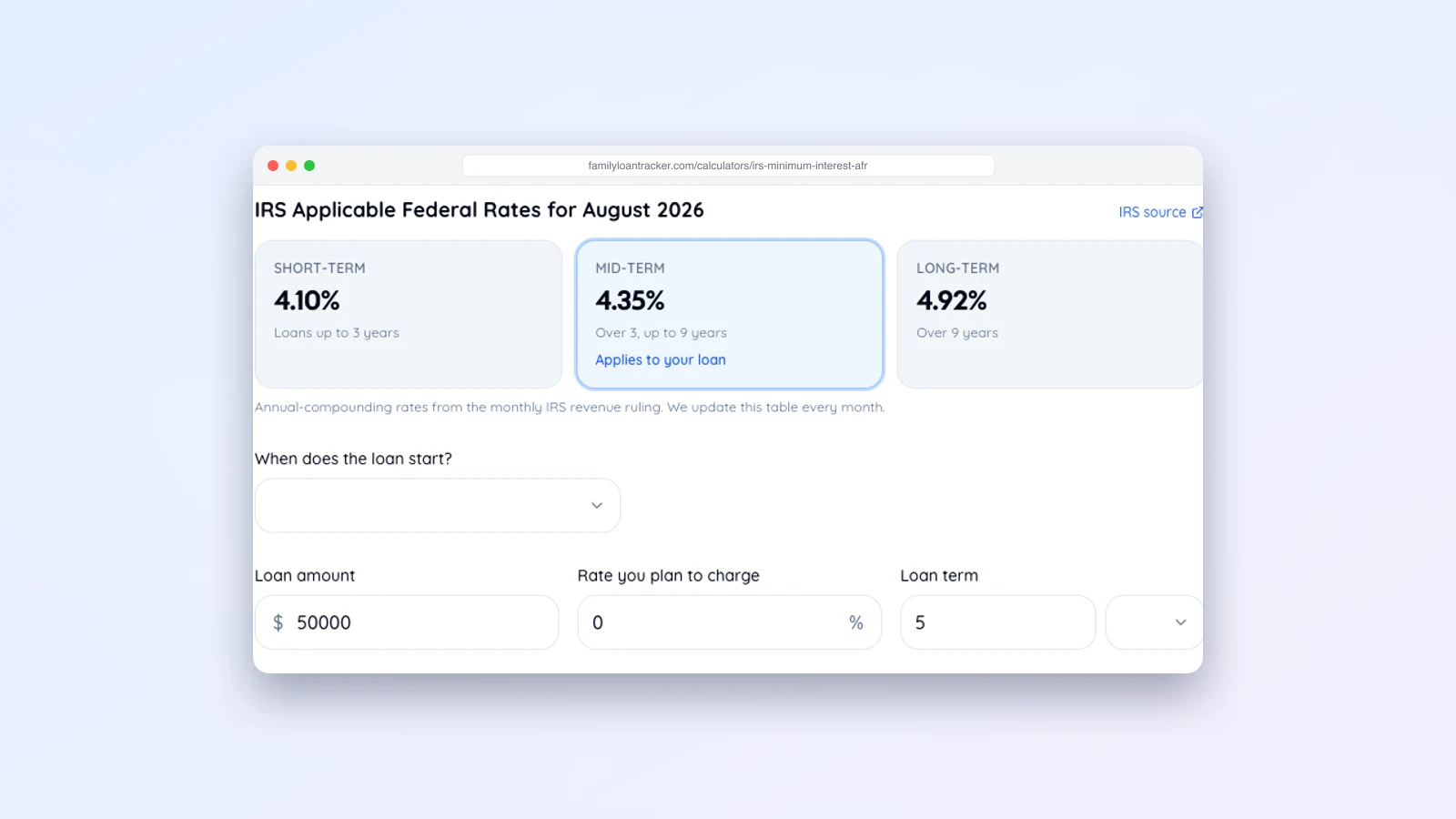
The IRS updates the AFR table monthly. The most reliable source is IRS.gov/applicable-federal-rates, which lists all three tiers for the current and recent months. For a faster check, our free AFR calculator shows this month's rates and tells you which tier applies to your loan term.
When you use the rate, note which tier applies based on your loan's term. A 7-year loan uses the mid-term rate; a 15-year loan uses the long-term rate.
AFR and family loan documentation
Charging the AFR rate is not enough on its own. The IRS also looks for evidence that the transaction is a genuine loan — a written agreement, a repayment schedule, and actual repayments being made. A loan charged at the AFR rate but never repaid is more likely to be reclassified as a gift regardless of the rate.
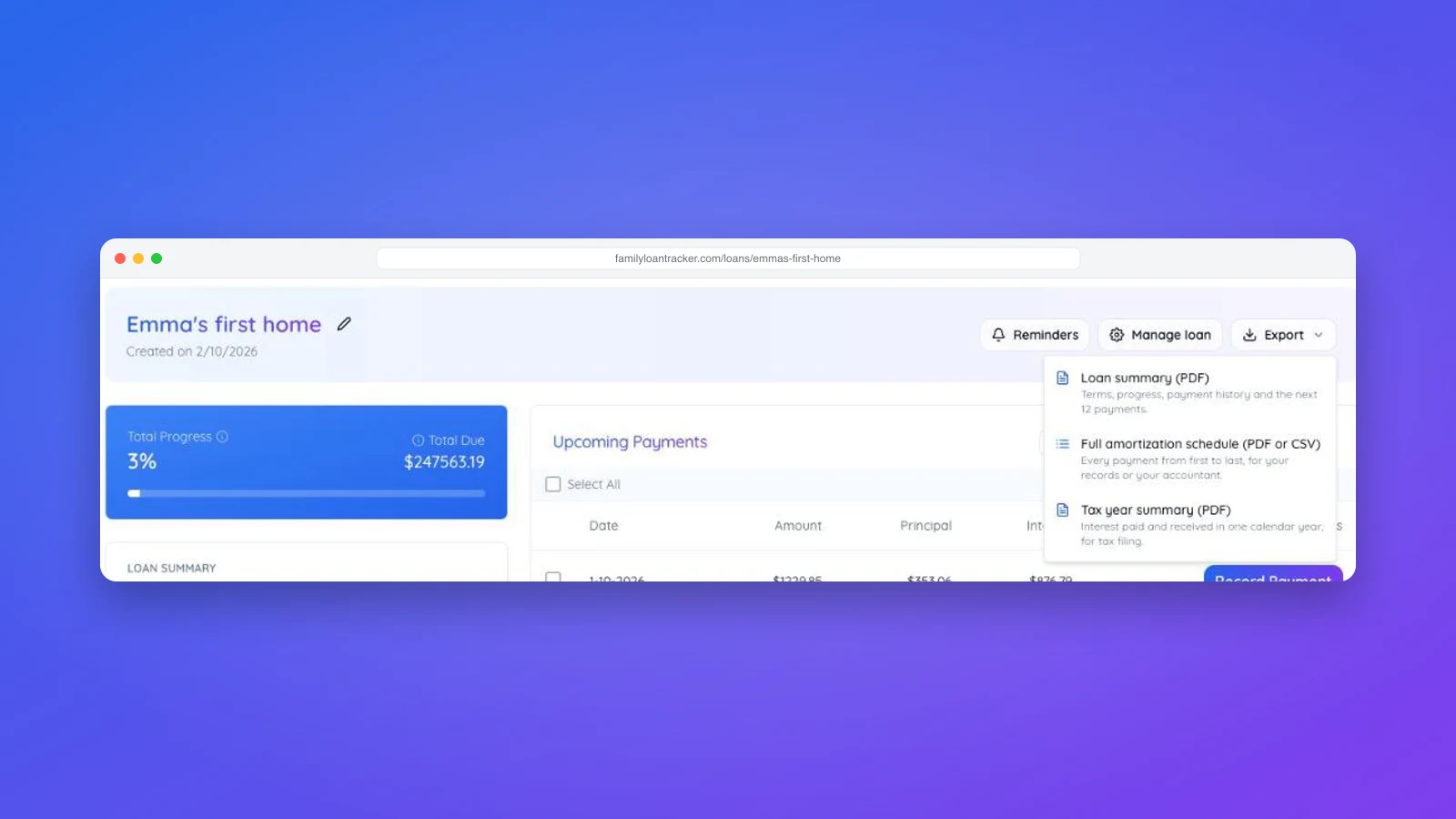
When you set up a loan in Family Loan Tracker, you can enter any interest rate and the tool calculates exact payment schedules and interest totals, making it straightforward to confirm you're meeting the AFR minimum before committing. A complete payment history in the tracker also serves as documentation of actual repayments — an important part of demonstrating genuine loan intent.
For a deeper look at what the IRS considers a legitimate family loan — and how documentation affects that determination — see our complete family loan tax guide, which covers imputed interest, gift tax implications, and Form 1099-INT in full detail.