Quick answer: choose a lump sum when your family member needs all the money at once and you want the simplest possible loan. Choose a line of credit when the money will be taken in stages, because interest only runs on what has actually been withdrawn. Most family loans are lump sums, but more families now use a line of credit for renovations, tuition, or funding a business over time. Here is how to tell which one fits, and how each is tracked.
What a lump sum family loan is
A lump sum is the classic setup. You transfer the full amount on one date, and repayment begins on a schedule you both agree on. Interest accrues on the whole balance from day one, or from a disbursement date you set. It is predictable and easy to explain, which is exactly why it is the default for most family lending.
This structure fits when:
- The borrower needs the entire amount now, such as a car, a down payment, or clearing a debt.
- You want one clear number and one fixed schedule.
- There is no reason to spread the money out over time.
What a family line of credit is
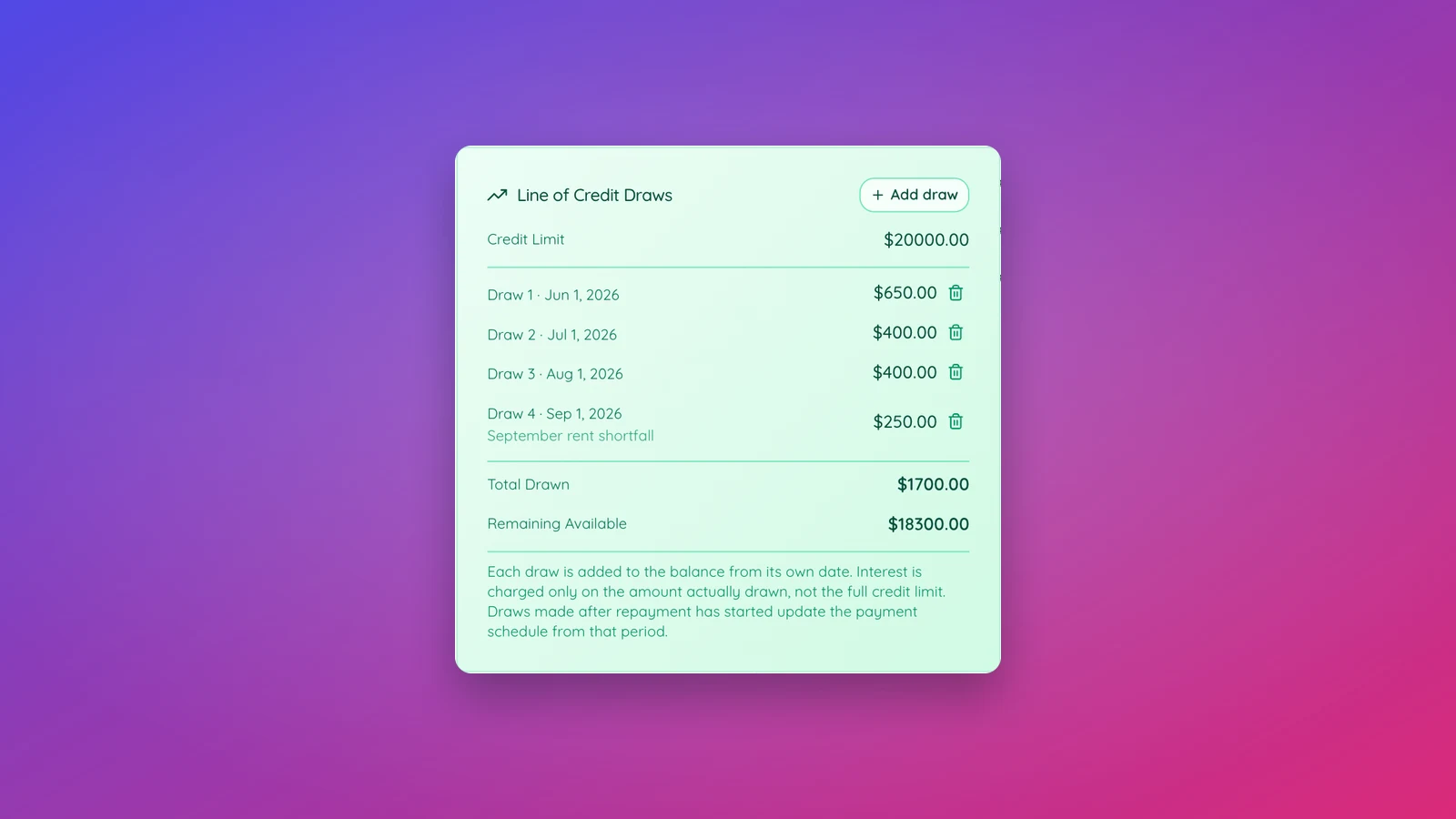
A line of credit flips the model. Instead of one transfer, you commit a maximum, the credit limit, and your family member withdraws it in stages called draws. Each draw starts accruing interest from its own date, so the borrower is never charged for money still sitting unused in the commitment.
A quick note on wording, because it trips people up. A draw is money going from lender to borrower, which raises the balance. A payment is money going back the other way, which lowers it. A draw is not a repayment.
This structure fits when:
- The money is needed in phases, such as a renovation billed as work finishes, tuition each semester, or a business runway.
- You want to cap your total exposure while charging interest only on what is used.
- The borrower values the flexibility of pulling funds as they go.
- The debt is not planned in advance but grows as it happens, such as unpaid rent or bills you cover each month and add to what is owed. You add each amount as a draw when it happens, even after repayment has started.
For the mechanics of setting one up and how the per-draw interest is calculated, see our guide on tracking a family line of credit with multiple withdrawals.
Side by side
| Lump sum | Line of credit | |
|---|---|---|
| Money released | All at once | In stages (draws) |
| Interest accrues on | Full balance from day one | Only what has been drawn, per draw date |
| Best for | A single, known need | Costs spread over time |
| Complexity | Lowest | Slightly higher |
| Total exposure | The loan amount | Capped at the credit limit |
How interest differs in practice
With a lump sum, interest is straightforward. The whole principal compounds from the start, and your schedule is built on that number.
With a line of credit, each tranche compounds from its own date. Say you commit $100,000 and your family member draws $40,000 in March and $30,000 in September. Interest runs on $40,000 from March, then on $70,000 from September. The remaining $30,000 of the limit costs nothing until it is drawn. That is the whole point. You protect the borrower from paying for money they have not touched yet.
If you expect extra or early repayments in either structure, the balance should recompute cleanly. We cover that in how to recalculate your loan balance after extra payments.
Which should you choose?
Start with one question: will the money leave your account in one go, or over time?
- One transfer for one need: use a lump sum. It is simpler and everyone understands it.
- Several transfers over months or years: use a line of credit, so interest tracks reality instead of overcharging.
If you are still weighing family lending against other options, our bank loan vs. family loan comparison and our overview of family mortgage loan repayment structures go deeper on the trade-offs.
Whichever you pick, put it in writing. You can create a clear agreement in minutes with our free loan agreement generator, then track every payment and draw in one place. Create your free account to get started.