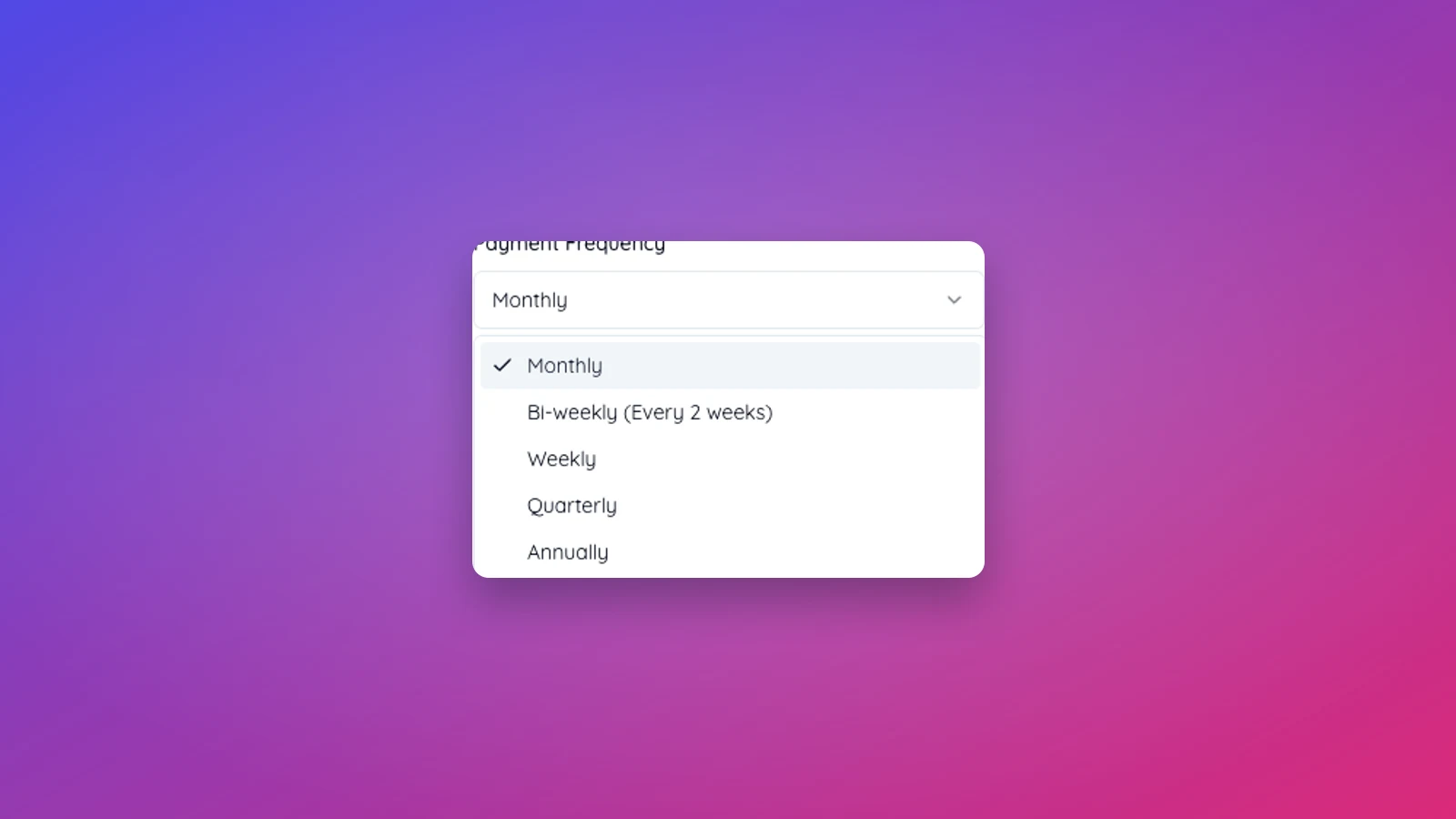
This guide explains how the payment frequency you pick when setting up a loan affects total interest, monthly cash flow, and how often the loan comes up in your relationship. Family Loan Tracker supports five frequencies — weekly, biweekly, monthly, quarterly, and annually — and you choose one when creating the loan.
The decision matters less than people sometimes assume on the interest side, and more than they assume on the relationship side. Both deserve a moment's thought.
How the frequency choice works
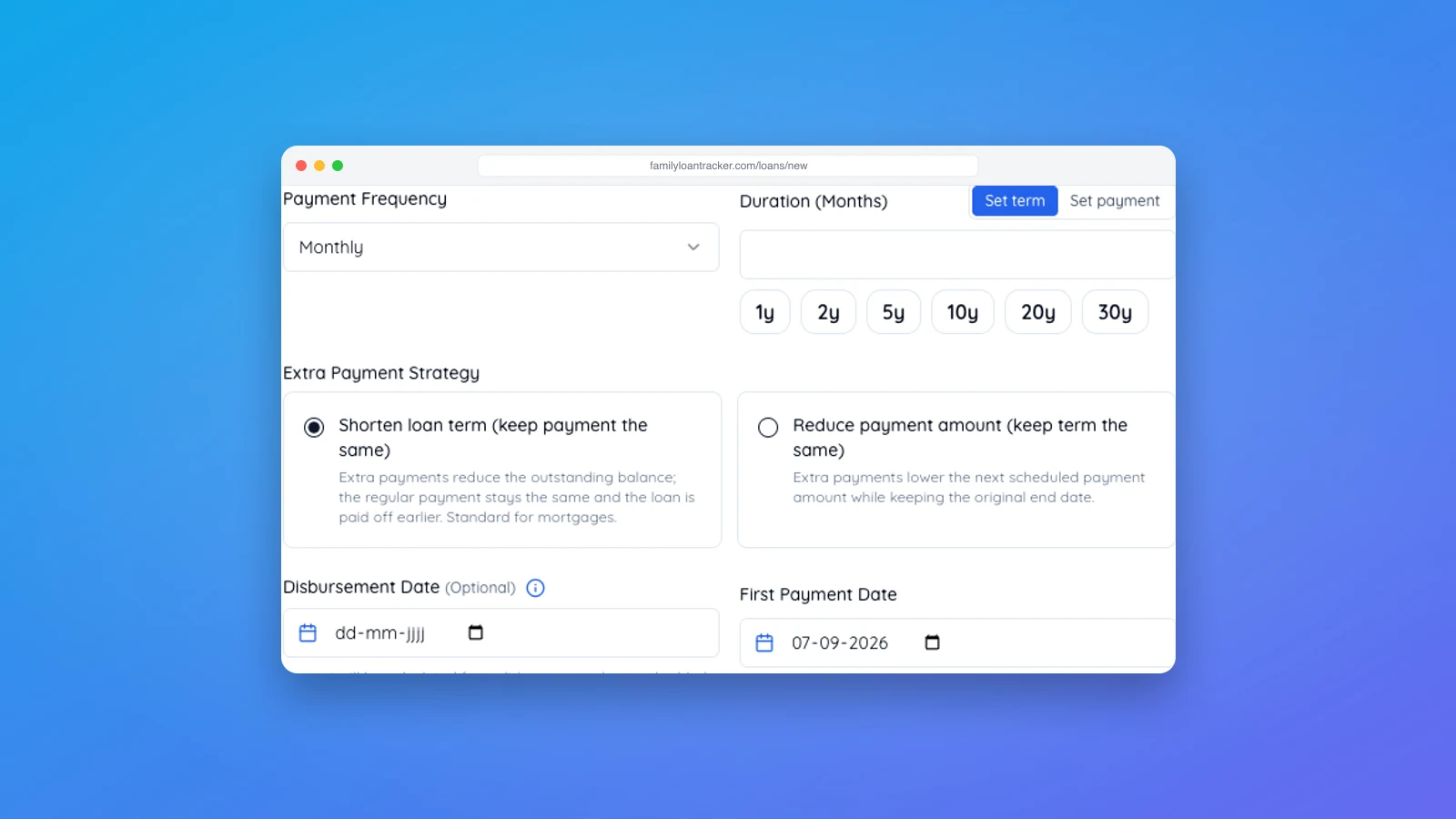
When you create a loan, the Payment frequency selector determines how the total schedule is divided. A 5-year loan paid monthly is 60 payments. The same loan paid biweekly is 130 payments. The same loan paid annually is 5 payments.
The tracker recalculates the payment amount, the full amortization schedule, and the total interest the moment you change the frequency. There's no separate setting for this — frequency is part of the loan's defining terms, alongside amount, rate, and duration.
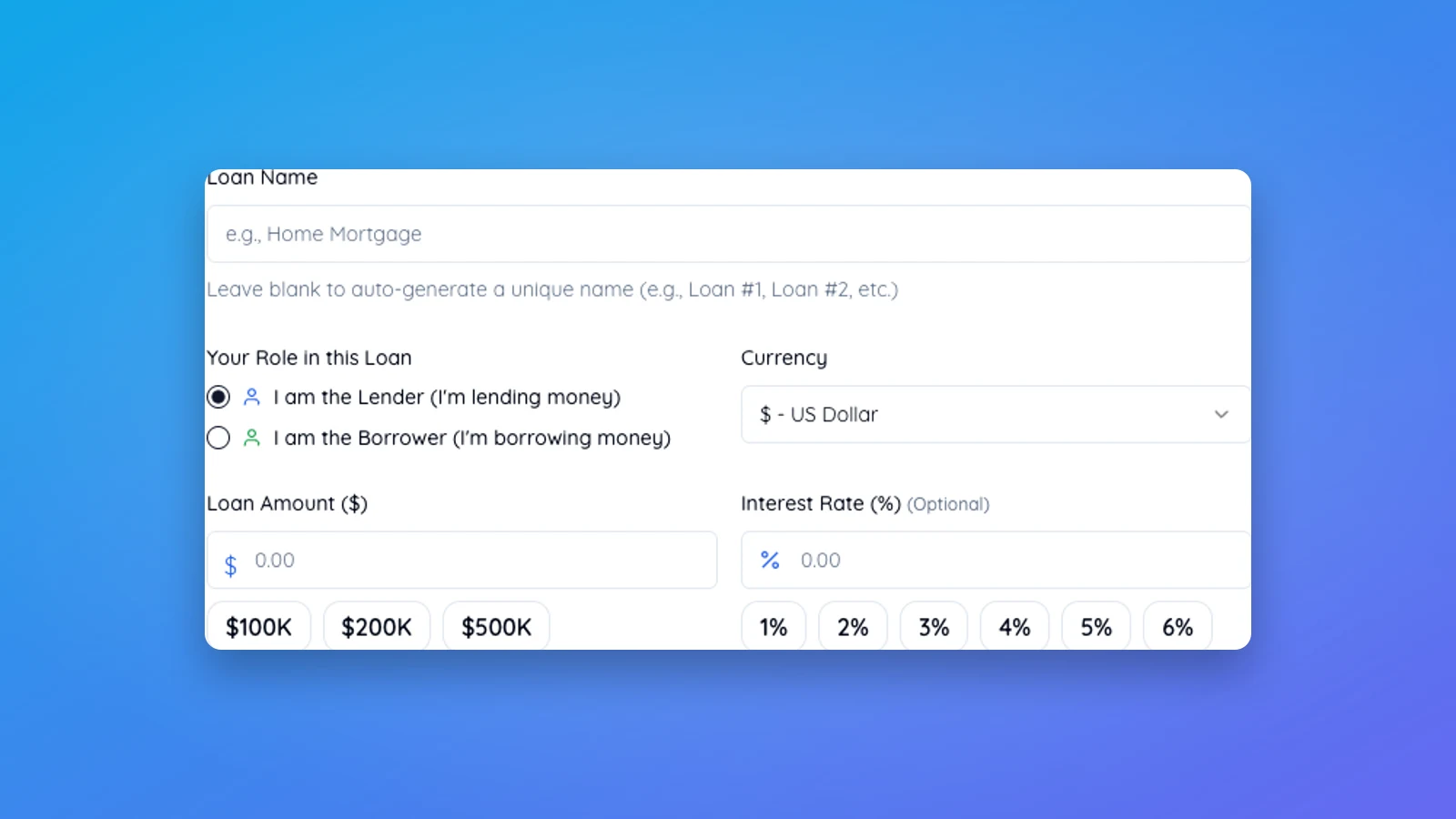
For a walkthrough of every field in the form, see our guide on how to set up a loan in Family Loan Tracker.
Why frequency affects total interest
Interest accrues on the remaining principal. The faster you pay down principal, the less interest accumulates over the life of the loan. More frequent payments reduce the average outstanding balance — even if the total annual amount paid is the same — which slightly reduces total interest.
The effect is real but modest at typical family-loan rates. Here's the same loan paid five different ways.
Comparison: $25,000 loan at 4% over 5 years
| Frequency | Payment amount | Number of payments | Total paid | Total interest |
|---|---|---|---|---|
| Weekly | ~$106.08 | 260 | ~$27,582 | ~$2,582 |
| Biweekly | ~$212.32 | 130 | ~$27,602 | ~$2,602 |
| Monthly | ~$460.30 | 60 | ~$27,618 | ~$2,618 |
| Quarterly | ~$1,385.38 | 20 | ~$27,708 | ~$2,708 |
| Annually | ~$5,615.69 | 5 | ~$28,078 | ~$3,078 |
The total interest range from weekly to annual is about $496 on a $25,000 loan — roughly 2% of the principal. Not nothing, but not the main reason to pick one frequency over another. The deeper effect is on cash flow.
Cash flow: how each frequency feels week to week
A monthly payment is the most common default because most household income arrives monthly and most household bills run on monthly cycles. It usually requires no special thought.
Weekly and biweekly payments keep the loan present in the borrower's awareness. Some people prefer that — it becomes part of the rhythm of paychecks and feels manageable in small bites. Others find it tedious to log a payment 260 times over five years.
Plain biweekly does not pay the loan off any faster than monthly on its own; it is the same total, split into smaller, more frequent pieces. The trick that actually shortens a loan is halving the monthly payment and paying that every two weeks, which works out to thirteen monthly-equivalent payments a year instead of twelve. When you set a loan by term rather than by payment amount, Family Loan Tracker offers this accelerated schedule directly and shows the years and interest it saves before you apply it.
Quarterly payments are uncommon but useful for borrowers with irregular income — small business owners, freelancers, or anyone paid on commission or bonus. A larger payment four times a year can be easier than scraping together a monthly amount during a slow stretch.
Annual payments make sense in specific cases: family loans tied to a yearly bonus, agricultural income, or situations where both parties prefer minimal administrative overhead. The trade-off is a noticeably higher total interest and the risk that a single missed payment derails the schedule for a full year.
The relationship dimension
Every payment is a touchpoint. More frequent payments mean more frequent moments where the loan exists between you and the other person — confirmations, reminders, the small social act of acknowledging the obligation.
For lenders, frequent payments offer earlier warning if something goes wrong. A missed weekly payment surfaces in days; a missed annual payment can mask a year of difficulty. For borrowers, frequent payments can either reduce anxiety (steady, predictable progress) or amplify it (a recurring reminder of the debt). Neither is objectively right — it depends on the people.
Family Loan Tracker sends optional reminders and confirmation emails around each scheduled payment, so a higher frequency does not necessarily mean more manual coordination — but it does mean more visible activity in both parties' inboxes.
How to pick
Use monthly as the default unless you have a specific reason to deviate.
Choose weekly or biweekly if the borrower is paid on that cycle and finds smaller amounts easier to absorb. Some borrowers also prefer the slightly lower total interest and the feeling of constant progress.
Choose quarterly if the borrower's income arrives in chunks — quarterly distributions, seasonal earnings, or commission cycles.
Choose annually only when both parties want minimum administrative overhead and the borrower has reliable annual income to cover the full amount. Be aware the total interest will be slightly higher.
You can change the frequency later through Manage loan, but only while the loan has no recorded payments yet; each payment is tied to a due date, so the option locks once the first one is logged. For a worked example of how the tracker recalculates after major schedule changes, see our guide on how to recalculate a loan after extra payments.