Imputed interest is interest the IRS treats you as having earned on a loan, even when no actual interest changed hands. It applies when you lend money to a family member or related party at a rate below the IRS minimum — the Applicable Federal Rate (AFR) — and it can create tax consequences for both the lender and the borrower.
The rule was written to prevent below-market family loans from being used as a workaround for gift tax.
Quick answer: If you lend a family member more than $10,000 at an interest rate below the AFR, the IRS treats the difference between the AFR and what you actually charged as "imputed interest." That foregone interest is treated simultaneously as a gift from you to the borrower and as taxable income you received — even though no cash moved. Charging at least the AFR avoids both consequences.
When imputed interest applies
The imputed interest rules apply to "below-market loans" between related parties, which the IRS defines broadly to include family members, controlled corporations, and certain trusts. For a typical family loan, the rules apply if all three of the following are true:
- The loan exceeds $10,000
- The interest rate is below the AFR in effect when the loan was made
- The loan is between related parties
Loans of $10,000 or less are generally exempt from imputed interest treatment under the de minimis exception, provided the loan is not used to purchase income-producing assets. For most informal small-dollar family loans, this exception applies and imputed interest never comes up.
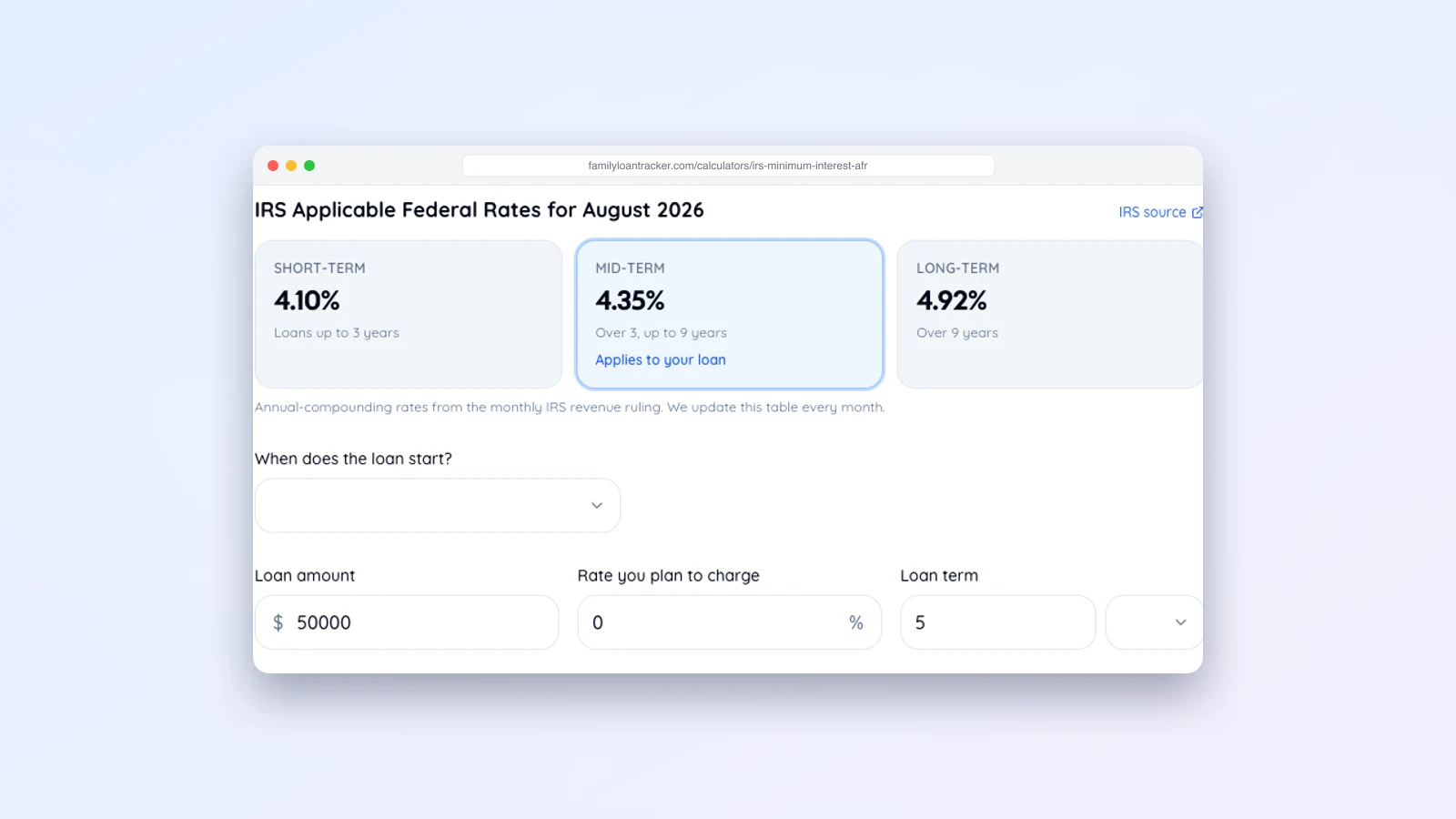
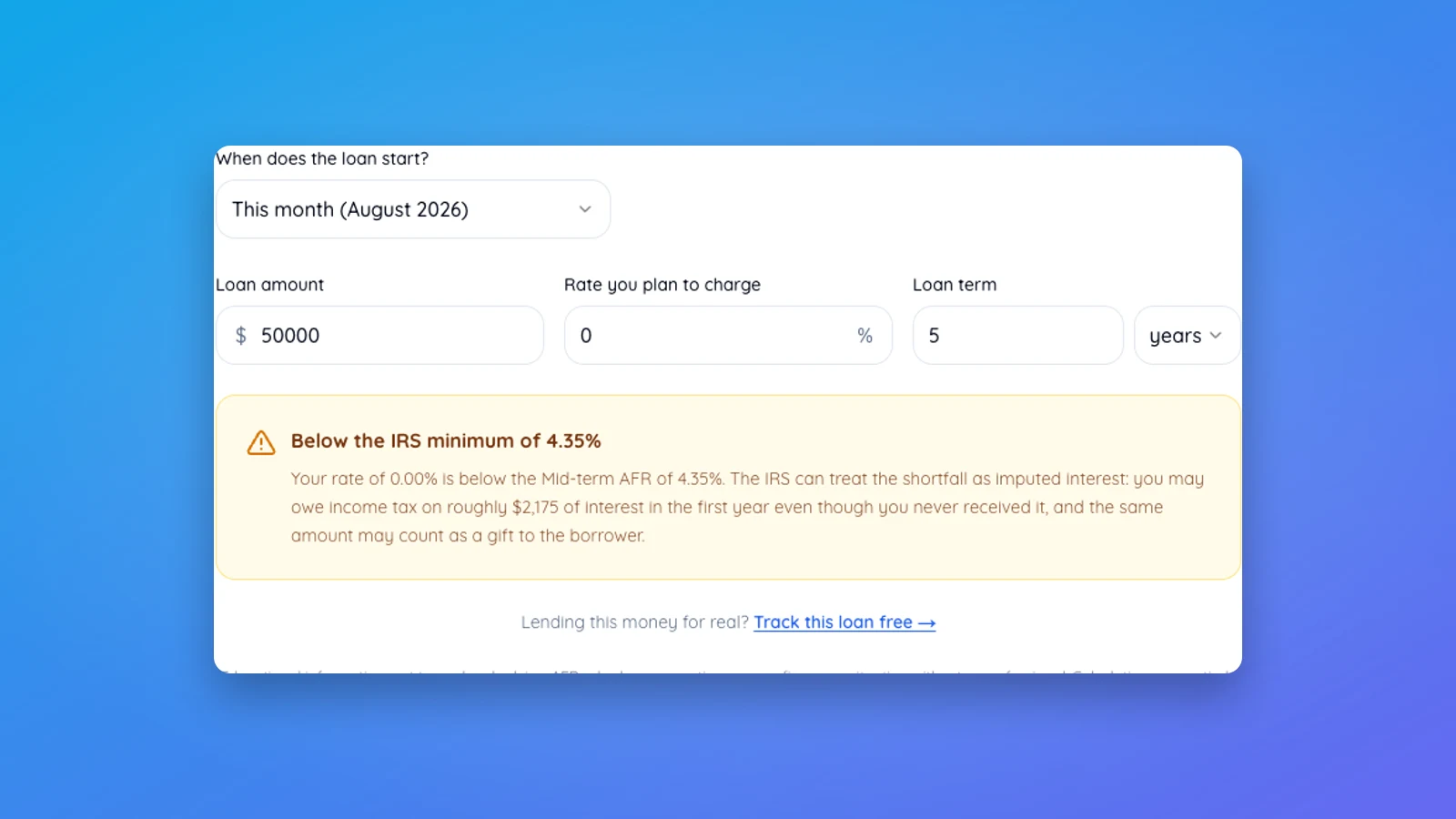
For larger loans, the AFR is the threshold to clear. The AFR is published monthly by the IRS — current rates for short-term, mid-term, and long-term loans are available on IRS.gov. For a full explanation of how the AFR works, see our guide on the Applicable Federal Rate. You can also run your own numbers through our free IRS minimum interest calculator, which estimates the imputed interest when your rate sits below this month's floor.
How imputed interest is calculated
Imputed interest is the difference between the interest the AFR would have produced and the interest you actually charged. The calculation runs each year the loan is outstanding.
Worked example. You lend your daughter $50,000 at 0% interest, repayable over 5 years. Say the mid-term AFR at origination was 4.0%. Each year, the IRS treats you as if you had charged 4.0% on the outstanding balance.
In year one, the imputed interest is approximately $50,000 × 4.0% = $2,000. That $2,000 is treated as foregone interest — interest you "should have" charged but didn't. As the loan principal pays down (if it does), the imputed amount in later years falls accordingly.
If you charged 1.5% instead of 0%, the imputed interest in year one would be the difference: ($50,000 × 4.0%) − ($50,000 × 1.5%) = $2,000 − $750 = $1,250.
The double consequence
The unusual feature of imputed interest is that the foregone amount is treated as flowing through two transactions at once.
First, it's treated as a gift from lender to borrower. Conceptually, the IRS treats the lender as if they had given the foregone interest to the borrower. This counts against the lender's annual gift tax exclusion. If the imputed interest plus any other gifts to the same person in the year exceeds the annual exclusion amount, the lender must file Form 709 — the gift tax return. Most lenders don't owe gift tax at this stage because of the substantial lifetime exemption, but the filing requirement still applies. We cover the mechanics of the annual gift tax exclusion in a dedicated guide on the gift tax exclusion and how it interacts with family lending.
Second, it's treated as taxable income the lender received. Even though the cash never arrived, the lender is treated as if they received the foregone interest as ordinary income — typically reportable on Schedule B of Form 1040, along with any actual interest income.
The result is that lending below the AFR can create real tax cost: the lender may owe income tax on interest they never received, and they may use up annual gift tax exclusion they could have used elsewhere.
The investment-income cap on $10,001–$100,000 loans
For loans between $10,001 and $100,000, the IRS softens the rule with an investment-income cap. The amount of imputed interest is limited to the borrower's net investment income for the year. If the borrower has $1,000 in investment income, imputed interest is capped at $1,000 — even if the below-AFR shortfall is higher. If the borrower's investment income is less than $1,000, imputed interest may be zero.
This cap does not apply to loans over $100,000. Above that threshold, the full imputed interest amount applies regardless of the borrower's investment income.
How to avoid imputed interest
The cleanest way to avoid imputed interest is to charge at least the AFR in effect when the loan was made. The AFR is a floor, not a ceiling — you can charge any rate at or above it.
Family Loan Tracker lets you set any interest rate when creating a loan. If you're unsure whether your rate clears the AFR threshold, our free loan agreement generator shows the exact monthly interest and total cost so you can compare your rate against the current AFR before signing. The tracker also keeps a complete payment history — useful documentation that a transaction was treated as a genuine loan rather than a gift, which matters separately from the AFR question. For a deeper dive into how the IRS distinguishes a real loan from a gift — and the documentation that supports the loan characterization — our complete family loan tax guide covers the full picture.
Reporting imputed interest
When imputed interest applies, the lender reports it as interest income on Schedule B of Form 1040 alongside any actual interest received. There's no specific IRS form labeled "imputed interest" — it folds into ordinary interest income.
The borrower generally doesn't report imputed interest as income (it's treated as a gift to them, not earnings), but the lender may need to file Form 709 if the imputed amount, combined with other gifts to that person in the same year, exceeds the annual exclusion.
If you've been running a family loan informally and now want to formalize it — or you suspect imputed interest applies and you didn't report it in prior years — talk to a tax professional. They can help you assess any retroactive exposure and decide whether to amend prior returns.