Someone in your family owes you money, and the amount is not fixed. Maybe you rent them a property and the rent comes up short some months. Maybe you cover a bill, or a car repair, and add it to what they already owe. The debt grows a little at a time, nobody wrote down a loan amount on day one, and the whole thing lives in a spreadsheet that one of you keeps and the other never sees.
This is one of the most common family money arrangements there is, and one of the hardest to track well. Here is how to turn a growing debt into a clear, shared record that both sides trust, without turning family into a bank.
Why a growing debt is harder than a loan
A normal loan has a shape. You lend $10,000, the schedule says $300 a month, and everyone knows where it ends. A debt that grows has no shape yet. Each month it moves in one direction or the other, and three things go wrong in the spreadsheet almost every time.
- Only one person can see it. The person owed money keeps the file. The person who owes it hears a number now and then and has to take it on trust. That is where resentment starts, on both sides.
- Interest, if any, is guessed. Charging interest on a balance that changes every month by hand is tedious, so people either skip it or approximate it. Neither is fair to the other side.
- Nobody knows what "paid back" means. When the borrower hands over $500, is that this month's shortfall, part of last year's, or a repayment of the total? Without a record that separates money added from money repaid, the answer is a shrug.
A shared, dated ledger fixes all three. The tool for that is a line of credit, not a lump sum loan.
Set it up as a line of credit, not a loan
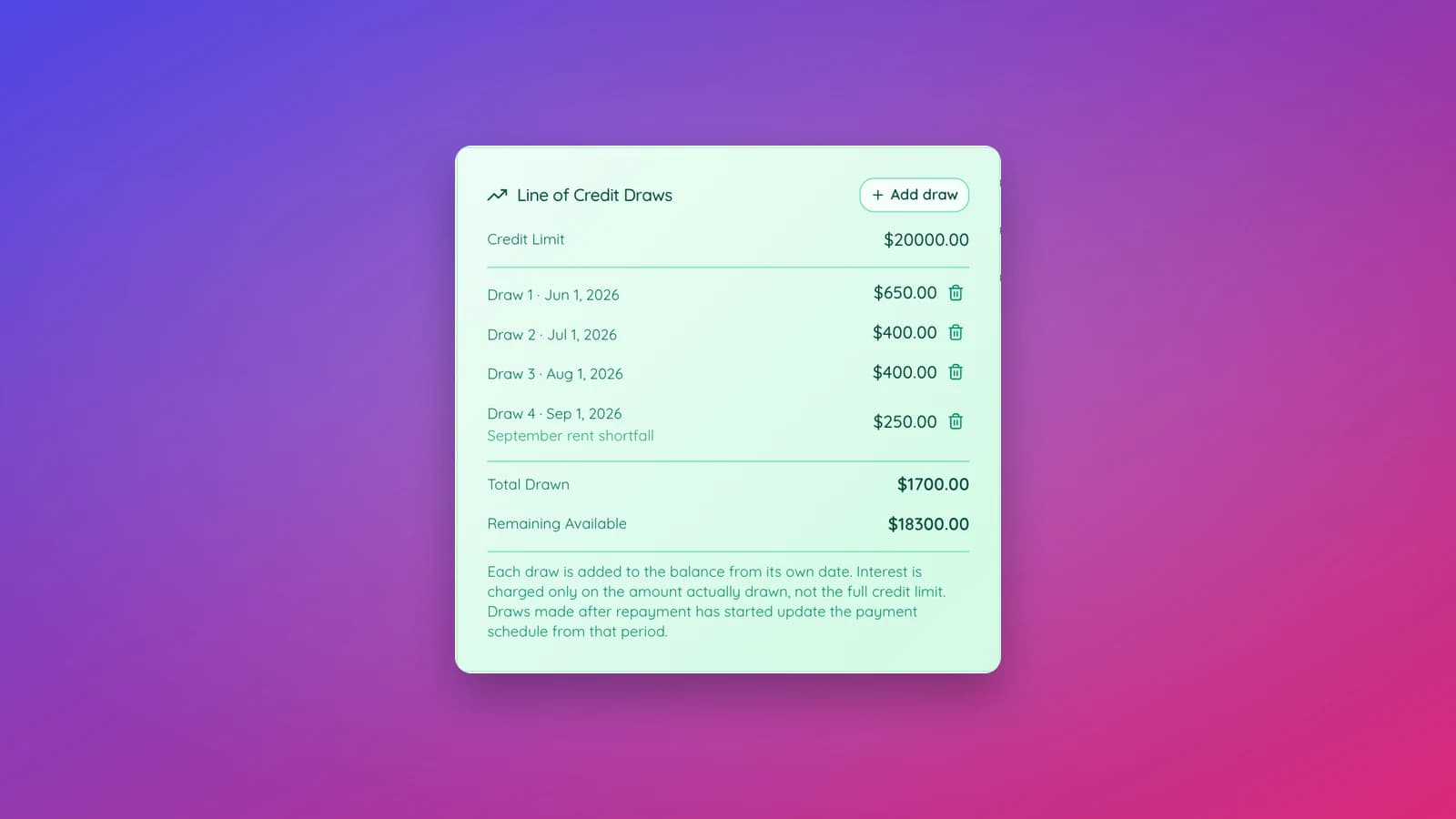
A line of credit records a credit limit (the most the debt may grow to), and then a series of draws, each with an amount and a date. Every draw raises the balance from its own date. Repayments come off the balance as they happen. You never have to know the final amount up front, because there is no final amount, only what is owed today.
That maps onto a growing family debt exactly:
- The unpaid part of this month's rent is a draw dated this month.
- The bill you covered in March is a draw dated in March.
- The $500 they paid you in June is a payment dated in June.
Interest, if you charge any, runs only on what has actually been drawn, never on the credit limit. If you are not charging interest, set the rate to 0% and the balance is simply everything added minus everything repaid. For the general trade-offs between the two structures, see lump sum vs. line of credit for a family loan.
Start tracking your loan free for 45 days, no card needed, and enter the balance as it stands today.
A worked example: unpaid rent
Say your daughter rents a house from you for $1,400 a month. Her hours were cut in the spring, and you agreed she pays what she can and the rest goes on the tab. June was $400 short, July $250, August $400. On August 20 she paid $200 toward the tab.
Set up a line of credit with a $20,000 limit (a ceiling you are comfortable with, not a target), 0% interest, and a first payment date of, say, January 2027, when you both expect her hours to be back. Then add three draws: $400 dated June 1, $250 dated July 1, $400 dated August 1, each with a one-line note like "June rent shortfall". Record the $200 as a payment on August 20.
The balance is $850. Not "about $850", not "somewhere between $800 and $900 depending on which version of the spreadsheet you open". $850, with every line that made it up visible to both of you.
When September comes up $250 short, you add one more draw. The balance updates the moment you save it, and your daughter gets an email with the amount and the new total. Nothing has to be explained over dinner.
Adding to the debt after repayment has started
The example above puts the repayment start in the future, which is the usual case while the debt is still growing. But life does not always cooperate. Repayment may have started, and then a new shortfall happens.
That works too. A draw dated after the first payment date is added to the balance in the month it falls in, and the remaining balance is spread over the rest of the agreed term. The monthly payment goes up a little; the end date stays where you both agreed it would be. The schedule row for that month says exactly what was added, so nobody has to wonder why the payment changed. The step-by-step is in our guide to tracking a family line of credit with multiple withdrawals.
Three decisions to make before you start
Interest or no interest? Most families do not charge interest on a rent shortfall, and that is fine. If the debt is large or long-running, be aware that the IRS expects at least the Applicable Federal Rate on family loans above $10,000 to avoid imputed interest. Our guide on what interest rate to charge on a family loan walks through the three options.
When does repayment start? Pick a real date, even a rough one. "When things settle down" is not a date, and a debt with no repayment plan is a gift that nobody has admitted to yet. You can change the date later if circumstances change.
Who sees it? Both of you. That is the whole point. Invite the other person to the loan so they see the same balance, the same list of draws and the same payment history you do. Transparency is not a lack of trust; it is what keeps trust intact when the number gets big.
When a spreadsheet is still fine
If the arrangement is short, small and interest-free, and you are both relaxed about it, a shared spreadsheet can do the job. The moment any of those stops being true (the balance passes a few thousand dollars, interest enters the picture, or one of you starts feeling uneasy), it is time for a proper record. Why spreadsheets fall short for loan tracking covers the failure modes in detail, and lending to adult children covers the conversation that usually comes before any of this.
Put the arrangement in writing as well, even between parent and child. A one-page agreement that names the credit limit, the interest rate (or 0%), and when repayment starts protects the relationship more than it protects the money. You can create a free loan agreement in a few minutes, then track every draw and payment against it.

