If the money went out before the first payment is due, you might open your loan and find the balance is already higher than what you actually lent. That is not a bug. It is deferred interest, and it is worth understanding before it surprises you.
What causes it
Every loan has a disbursement date, when the money actually moved, and a first payment date, when repayment starts. If those two dates are the same, or close together, nothing unusual happens. If there is a real gap between them, months before the first payment is due, interest accrues during that gap the same way it would on any outstanding balance.
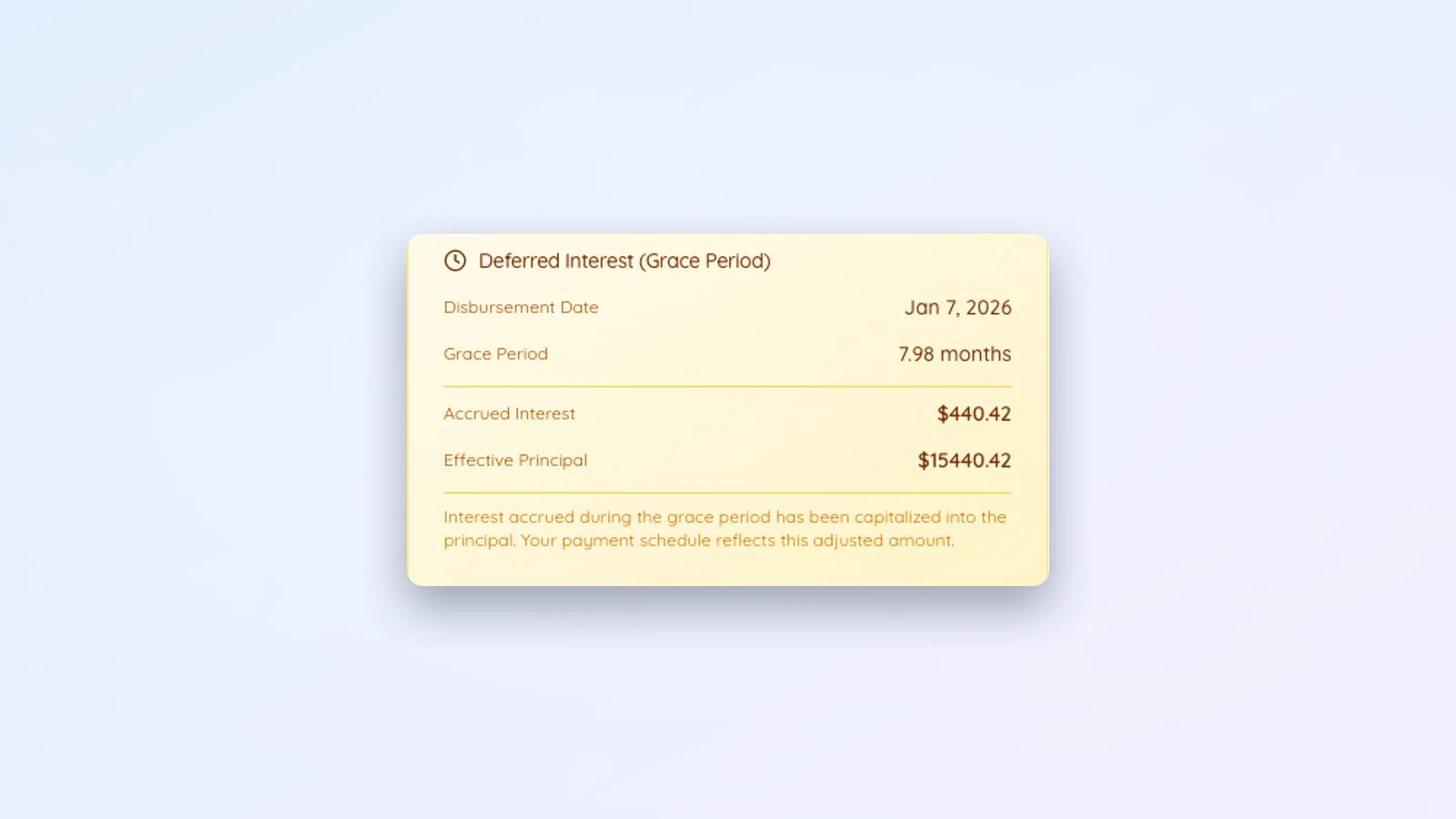
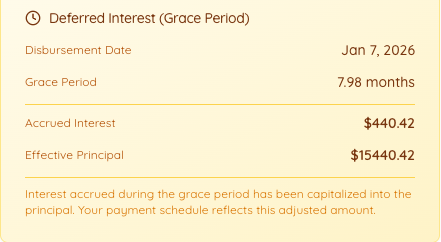
Family Loan Tracker detects this automatically and shows it as a Deferred Interest (Grace Period) card on the loan page.
Reading the card
Disbursement Date is when the clock started. Grace Period is how long the money sat before the first payment, in months. Accrued Interest is what built up during that stretch, calculated at the loan's normal rate. Effective Principal is the number that matters: your original principal plus that accrued interest, capitalized in. From the first payment onward, the schedule is built on the effective principal, not the amount you originally typed in.
A $15,000 loan disbursed eight months before the first payment, at 4.35%, accrues a bit over $440 in that gap. The schedule then runs on $15,440, not $15,000.
Why this is intentional, not a mistake
The alternative would be to pretend those months of grace never happened, which quietly gives the borrower free money and leaves the lender's numbers wrong from day one. Capitalizing the interest keeps the loan mathematically honest: the borrower had the use of the money during the grace period, so the loan reflects that.
When this shows up without you meaning it to
The usual trigger is a disbursement date entered out of habit, matching the day you actually sent the funds, paired with a first payment date chosen for convenience, the start of next month, say, months later. If that gap was not intentional, edit the loan's dates to bring the first payment closer to disbursement, or clear the disbursement date entirely if you would rather not track a grace period at all. Recalculating removes the deferred interest and returns the schedule to a plain calculation from the principal you entered.
This is one more reason to slow down at the loan setup step itself: the two dates are easy to fill in without thinking about the gap between them, and the gap is exactly what drives this.
What it does not do
Deferred interest is a one-time adjustment, not an ongoing penalty. Once the effective principal is set, the rest of the schedule behaves like any other loan: fixed payments, normal interest, no further surprises tied to the grace period itself.
A grace period like this is common when a loan is planned well ahead of when the money is actually needed, a home down payment saved toward over months, tuition due at the start of a semester. Our guide to planning a family loan covers how to time a loan like that on purpose rather than by accident.