A promissory note is a written, signed promise from one party (the borrower) to repay a specific sum of money to another party (the lender) under defined terms. It is one of the oldest financial instruments in use, and it is the document that turns a verbal "I'll pay you back" into a record both sides — and the IRS — can rely on.
Quick answer: A promissory note is a one-page legal document stating the loan amount, interest rate, repayment schedule, and consequences of non-payment, signed by the borrower. For family loans, it is not legally required in most jurisdictions, but it is strongly recommended — without one, the IRS can reclassify the loan as a gift, with significant tax consequences for the lender.
What a promissory note must contain
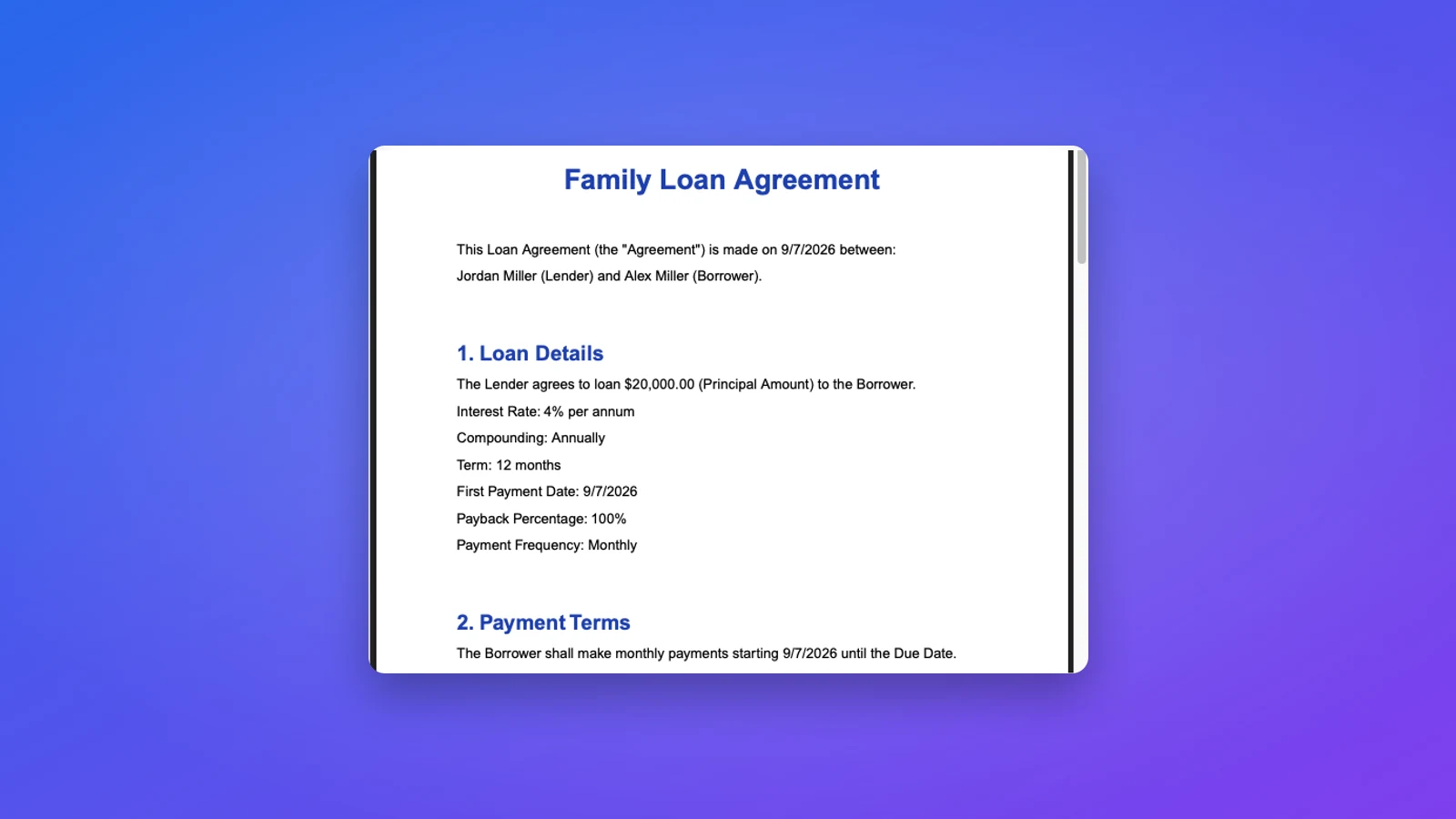
A valid promissory note covers six essentials:
- The parties. Full legal names of the borrower (the maker) and the lender (the payee).
- The principal. The exact amount of money being lent, in numerals and ideally also in words.
- The interest rate. Stated as an annual percentage. Even a zero-interest loan should state "0%" explicitly rather than leave the field blank.
- The repayment schedule. When payments are due (e.g. monthly on the 15th), the amount of each payment, and the final maturity date.
- Default terms. What happens if the borrower misses payments — late fees, grace periods, acceleration clauses, or the lender's right to demand the full balance.
- Signatures and date. The borrower's signature is required; the lender's is conventional but not always legally needed. Both parties should keep originals.
A note that is missing the principal, the rate, or the schedule is not really a promissory note — it is closer to an IOU, which carries far less legal and tax weight.
Promissory note vs. full loan agreement
A promissory note is the borrower's one-sided promise to pay. A loan agreement is a two-sided contract that spells out both parties' obligations — disbursement timing, prepayment rights, dispute resolution, collateral handling, governing law, and so on. In a family context the two are often combined into a single document.
For straightforward family loans (one lump sum, fixed schedule, no collateral), a promissory note alone is usually enough. For larger or more complex loans — secured by real estate, involving a guarantor, or with a non-standard payment structure — a fuller loan agreement is the better choice.
Why this matters for the IRS
The IRS treats every transfer of money between individuals as one of two things: a loan or a gift. Loans are not taxable events for either party. Gifts above the annual gift tax exclusion may trigger filing requirements and use up part of the lender's lifetime exemption.
For a transfer to be treated as a loan, the IRS looks for three things: a written agreement, an intent to repay, and actual repayment behavior. A promissory note covers the first directly and supports the second. Without one, an audit can reclassify the entire transfer as a gift — even years later — with retroactive tax consequences.
Charging at least the applicable federal rate strengthens the loan position further. If you charge below it, the IRS may impute interest income to you anyway. Our deep-dive on imputed interest explains the mechanics.
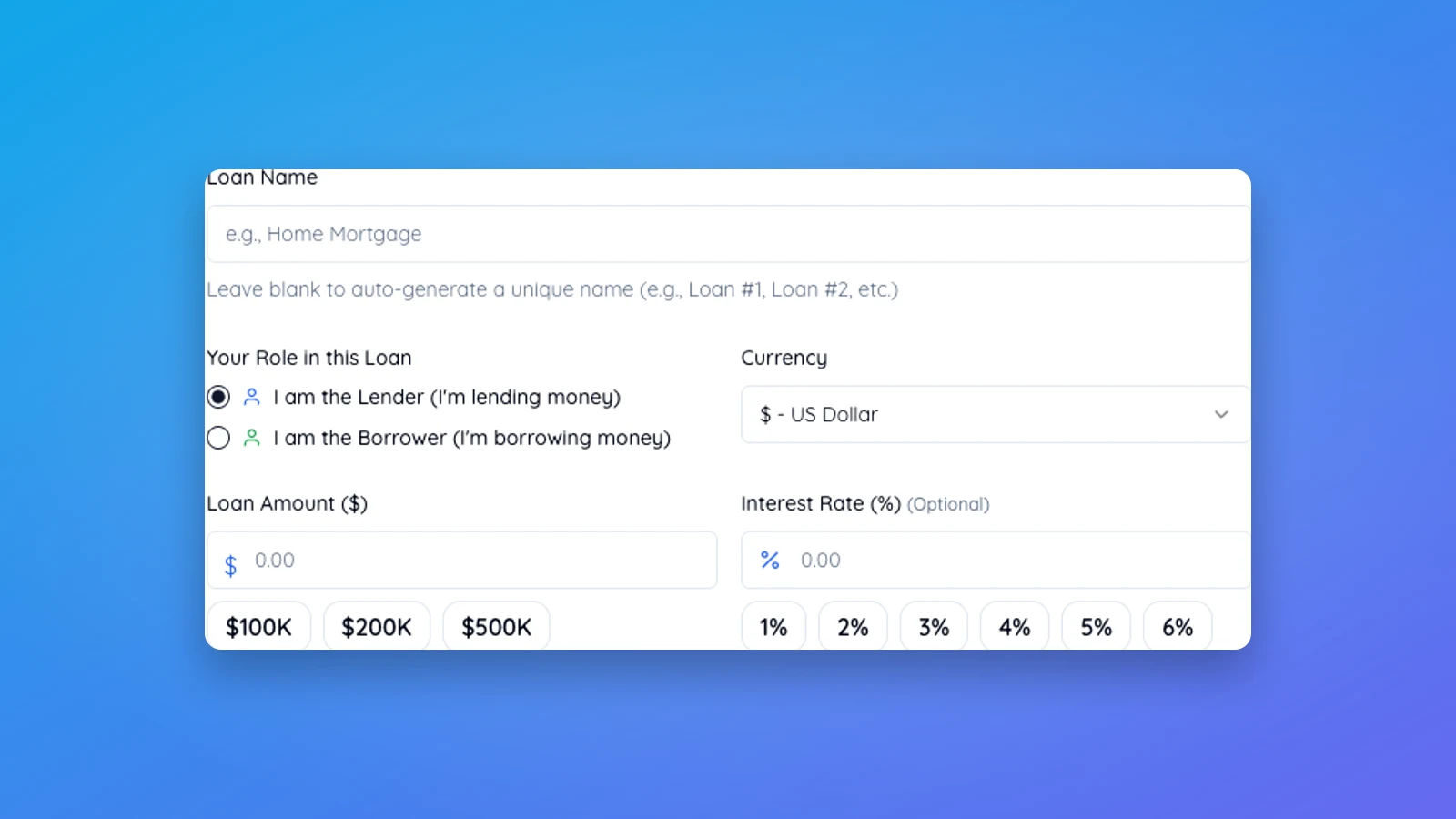
Family Loan Tracker's free agreement generator creates a complete promissory note in minutes — covering all the essential fields and generating a signed PDF you can store alongside your loan records.
Concrete example
A parent lends a child $40,000 to use as a down payment on a house. They agree informally that the child will pay it back "over the next few years."
Without a promissory note, the parent has no enforceable terms, no proof of intent to repay, and no documentation if the IRS later asks why $40,000 changed hands. If the parent dies before the loan is fully repaid, the executor of the estate may have no way to claim the outstanding balance.
With a one-page promissory note — $40,000 principal, 4% annual interest, monthly payments of $737 over 60 months, default after 30 days late — every one of those problems disappears. The note costs nothing to create but converts a financial favor into a legally clean transaction.
How to execute a promissory note
Signing a promissory note is straightforward:
- Fill in the six essentials (parties, principal, rate, schedule, default terms, date).
- The borrower signs in front of a witness or notary if you want extra evidentiary weight.
- Both parties keep an original signed copy.
- Store digital scans in a secure location — email, cloud drive, or password manager.
Notarization is rarely legally required for promissory notes in the United States, but it adds authentication value if a dispute reaches court. For loans secured by real estate, notarization (and recording with the county) is usually required by state law.
Witness signatures are a lower-cost alternative — a neutral third party attests they saw both parties sign on the stated date. This satisfies most evidentiary needs for unsecured family loans.
You can read the full legal background of promissory notes in Nolo's reference on promissory notes. For a longer narrative walkthrough of a family loan from agreement to repayment, our family loan agreement guide covers the practical side.
Once you have one — track it
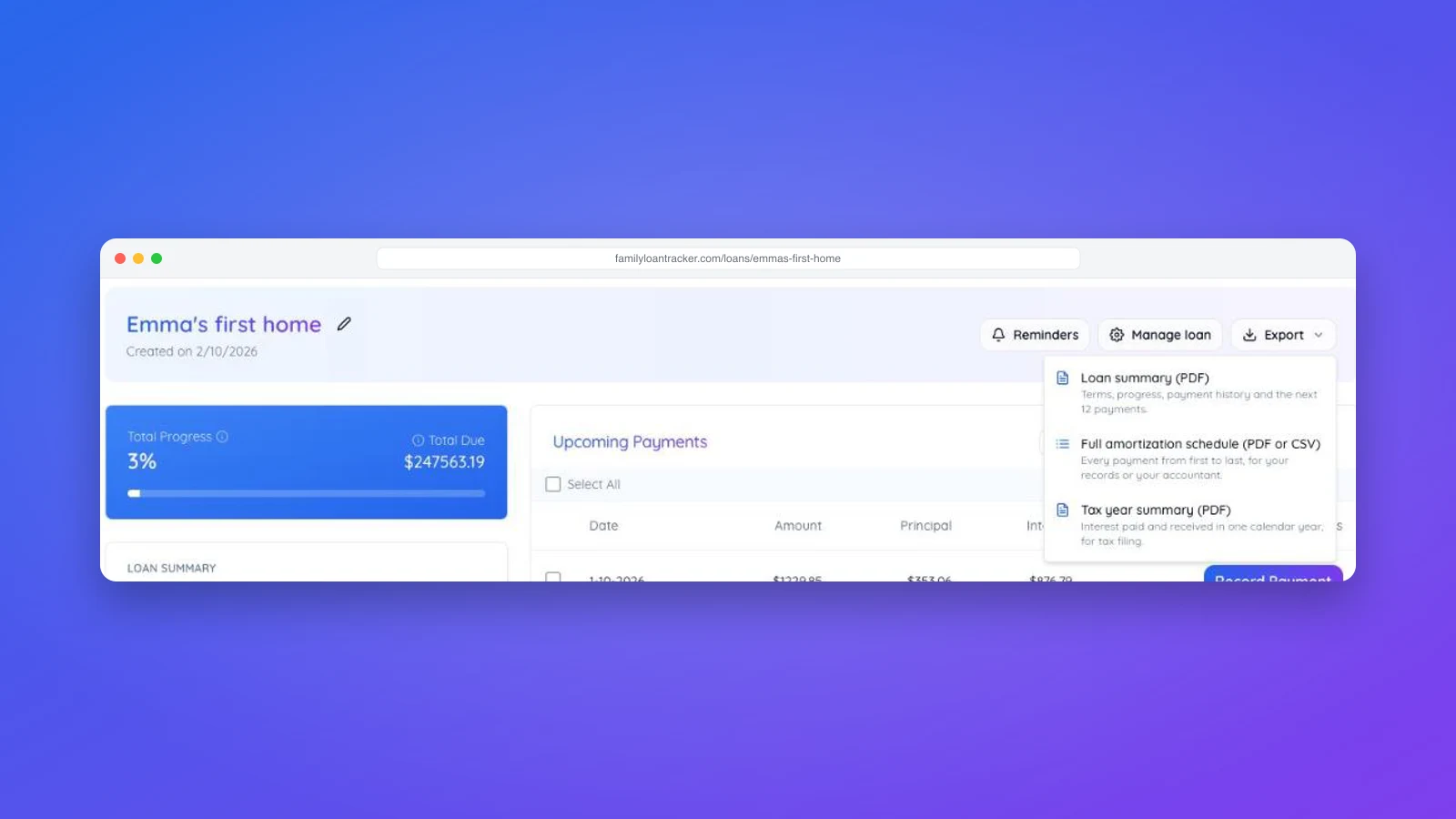
A signed promissory note is the starting line, not the finish line. The repayments still have to happen, and the lender still has to keep records. The cleanest pattern is to generate the note, then set up the loan in the tracker using the same terms — so every payment recorded going forward is matched to the signed document on file.