A "family loan," for IRS purposes, is money transferred between related parties with a genuine, documented expectation of repayment. Anyone related by blood, marriage, or — in many cases — a close personal relationship can be a party to one. What makes it a loan rather than a gift isn't the relationship; it's whether the facts support real repayment intent.
Quick answer: The IRS looks at three things to decide if a transfer between family members is a loan or a gift: was there a written agreement, was there a genuine intent for the money to be repaid, and did actual repayment happen (or is it on track to happen). Without these, an undocumented "loan" risks being reclassified as a gift — with gift tax consequences for the lender and no deduction if it later goes unpaid.
Who counts as "family" here
The IRS doesn't limit this to parents and children. Related-party rules under the tax code reach siblings, grandparents and grandchildren, in-laws, and in many practical situations, close friends where the same below-market-loan and gift-tax questions can arise. The label "family loan" is really shorthand for "loan between people who aren't dealing at arm's length" — the IRS scrutinizes these more closely than a loan between strangers, because there's less commercial pressure to document things properly.
The three-part test
When the IRS (or a court, in a dispute) needs to decide whether money that changed hands was a loan or a gift, it generally looks for three things.
1. A written agreement. A signed document specifying the amount, interest rate, repayment schedule, and maturity date is the clearest evidence of loan intent. Verbal understandings are not impossible to defend, but they put the burden of proof entirely on memory and credibility. Our guide on what a promissory note must contain covers the minimum elements an agreement needs.
2. Genuine intent to repay. This is judged by the substance of the arrangement, not just the paperwork. A "loan" with no realistic repayment schedule, no interest, and no history of follow-up if payments are missed looks, on the facts, more like a gift with loan-shaped paperwork attached. Charging at least the Applicable Federal Rate is one of the strongest signals of genuine intent, since it shows the arrangement wasn't structured purely to transfer wealth.
3. Actual repayment behavior. Payments that are actually made, on a schedule that's actually followed, are the strongest evidence a transfer was a loan. A pattern of skipped or "forgiven" payments — especially without any documentation of why — undermines the loan characterization retroactively, even years after the money changed hands.
No single factor is decisive on its own. A written agreement with no payment history is weak evidence. Consistent payments with no agreement are better, but still leave room for dispute about the original terms. All three together are what make a family loan defensible.
Why this distinction matters
If a transfer is recharacterized as a gift, several things follow. The "lender" may owe gift tax (or use up annual exclusion and lifetime exemption) on the full amount transferred, not just on any imputed interest. If the lender later writes off an unpaid balance expecting a bad debt deduction, that deduction is only available for a bona fide debt — a transfer the IRS treats as a gift from the outset was never a debt to begin with, so there's nothing to write off. For an explanation of what happens specifically when a documented loan isn't repaid, see our guide on imputed interest, which covers a related but distinct consequence of underpriced family loans.
The stakes scale with the amount. A $2,000 transfer that turns out to be a gift rarely matters — it's well under annual exclusion limits either way. A $150,000 transfer recharacterized as a gift can create real and unexpected gift tax exposure for the lender.
Documentation that demonstrates intent
Beyond the promissory note itself, the IRS and courts have looked favorably on supporting evidence such as: a payment schedule that was actually followed, correspondence (even informal emails or texts) discussing the loan as a loan, interest actually charged and reported as income by the lender, and consistent treatment on both parties' tax returns over time.
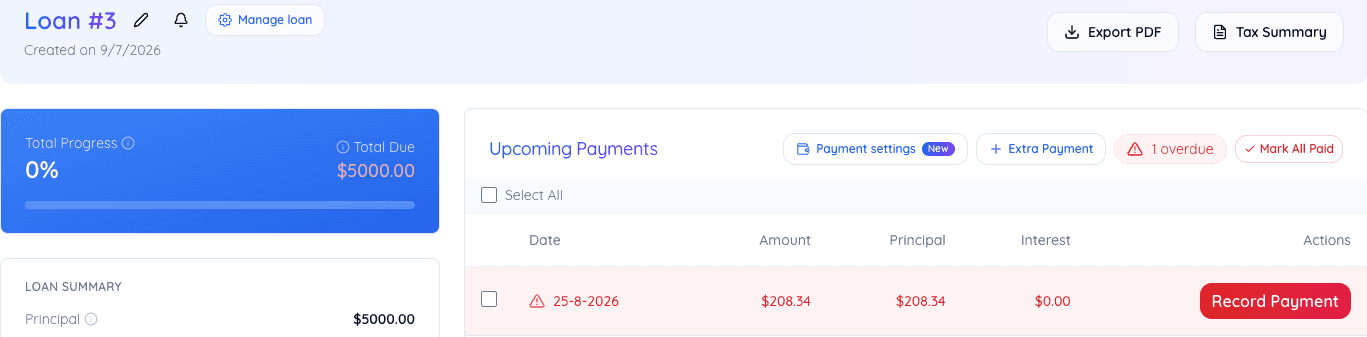
A tracked loan in Family Loan Tracker creates a payment-by-payment record of actual repayments — the kind of documentation that demonstrates genuine loan intent if the arrangement is ever questioned. Each payment is timestamped and categorized, building exactly the repayment history that supports the loan characterization rather than relying on memory after the fact.
When the line gets blurry
A few situations commonly raise the loan-versus-gift question even when everyone involved intended a real loan:
- Interest-free loans. Charging 0% doesn't automatically make a transfer a gift, but it removes one of the strongest indicators of loan intent and can trigger imputed interest rules on larger amounts.
- Loans that get partially forgiven. Forgiving missed payments occasionally is normal life; forgiving most or all of a loan on a pattern starts to look like the original transfer was never expected to be repaid in full.
- No fixed repayment date. A loan that's technically "payable on demand" with no demand ever made, year after year, invites the same scrutiny as an undocumented gift.
None of these situations automatically reclassify a transfer. They simply weaken the evidence if the question ever comes up — which is exactly why documentation matters most in the cases that look the most informal. The underlying rules on below-market loans and related-party transfers are laid out in IRS Publication 550, which is worth a direct read if your situation is borderline.